Tuesday, November 26, 2013

Marriage Customs Of The Malays

The activities that take place during a Malay wedding come from the diverse cultural traditions –indigenous, Hindu and Islamic–that have together served to shape traditional Malay culture. The numerous activities constitute a Malay wedding may be conveniently be divided into three groups representing three stages.
The first group of activities, all of which precede the actual wedding ceremony, consist of:

(a) The investigation (merisik).
When it is time for a young man to get married his family will look around to identify a number of potential candidates. Having decided upon one particular young lady, then, the 'merisik' of investigation process takes place. For this ceremony one or more representatives (wakil) of the young man’s family will pay a friendly visit to the family of the young woman whom they have in mind as his potential bride. The visit is purely for the purpose of further investigation. Its allows the visitors to see the young lady. A hint will be given to her parents regarding the purpose of the visit, and their reaction will be assessed. The girl’s parents may also give the visitors some idea as to whether or not their daughter will be interested in the match. The 'merisik' does not constitute a formal proposal. Following the visit both sides can begin to think more seriously about the possibility or otherwise of the union. It is possible that no progress may take place, and the young man’s parents or representatives will then look for another possible candidate.

(b) The engagement or approach to formulate the arrangement (meminang)
Once agreement for the marriage has been reached between the families of the potential bride and the potential bridegroom, preparations for engagement (meminang) take place. Representatives from the young man’s side once again visit the house of the young woman, following the confirmation of a date and time for such a visit.

(c) The 'hantaran' or the sending of gifts and part of the amount of money (wang belanja) for expenses (wang belanja) which the boy’s family give to the girl’s side that will be incurred by the girl’s family.
The 'wang belanja' is usually an amount of several thousand ringgit. It is different from the dowry (mas kahwin) which is also paid by the man to his future wife. The amount of the mas kahwin is usually fixed by the Islamic Religious Council in each state, but a potential bridegroom may give any amount above the official figure.

The second group of activities consists of the actual marriage ceremony (akad nikah) and (berinai), while the third group of activities consists of 'berarak'or arriving in procession, sitting on a decorated dias ( bersanding and the welcoming of the married couple to the bride’s house ( sambut menantu).


Monday, November 25, 2013

..ChiNesE CuLtuRe DaNcE..

Chinese dance has its own unique lexicon, significance, and organized fabrication that provide a platform to dance up to its full extent and represents the thoughts and feelings with contentment and elegance.


                                                          Traditional Chinese Dance


Traditional Chinese Dance includes the stalwart Lion Dance with drum music, the spirited Ribbon Dance with long Silk Ribbons fabricating calligraphic designs in the air as well as the exquisite Fan Dance mesmerized by spectators all over the world. The Art of Chinese Dance convoy the hue, extravagance and splendor of the Chinese culture all over the world.

                                                           Chinese Modern Dance

Chinese modern dance pioneers like Wu Xiaobang, Dai Ailian and Jia Zuoguang had intensive professional training in western modern dances. In their dancing, they not only retain the spirit of freedom and innovation, but more importantly, they pursue the national character of China and the trends of the time and combine that with what they were taught. 

WEDDING CUSTOMS OF THE IBANS


Ibans are Sarawak tribes. In Iban marriage customs, rituals split areca will be conducted during the event. A woman will bring out the betel and areca is then split. Breakdown nut will determine the length of time required bride living in the house of her husband. After that, a shaman ceremony will lull children and the children got it back with a few verses of poem. The wedding ceremony was considered the end of the run custom if there is no custom error committed by both sides. Tailor Crush will begin the ceremony. Chicken legs tied then released and mantras already read. Chicken blood will worship the bride. According to the Iban belief, ceremony will be held at the bride and groom then can not sleep with the bride.

The wedding ceremony is definitely the biggest day for both partners and families. The groom’s family will
throw a feast and the bridegroom’s family will help with the preparations. A wedding representative will be appointed to invite guests and this representative will take strands of rope with knot that are used to show the days left before the day of the wedding ceremony. If the rope has seven knots, the marriage will be held within seven days. The knots will then be opened every day.

Sunday, November 24, 2013

...MaLaY FooD...

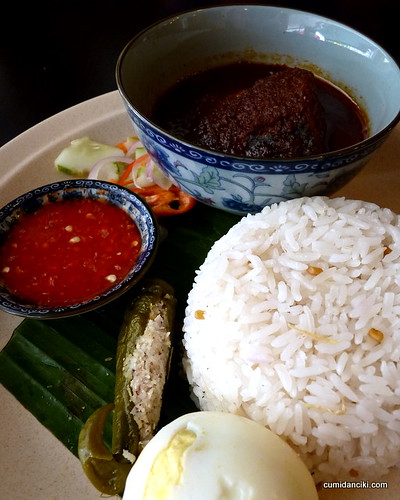
The way that Malaysian food is made is different depending on the area, but the foods that are cooked are all the same. The differing methods of preparation allow for variations in flavor and look of the foods. The main food in Malaysia is rice, but beef is very common as well. Since Malaysia does not have four seasons, there are always fresh vegetables. So, Malaysian breakfast includes a popular food known as nasi lemak.
                                                      1. Nasi Lemak
Coconut flavored rice meal is rice cooked in coconut milk made aromatic with screwpine leaves. It is typically served with "Sambal Ikan Bilis", fried dried anchovies cooked in a dry sambal sauce, and garnished with cucumber slices, hard boiled egg and roasted peanuts. Traditionally packaged in a banana leaf, it is usually eaten as hearty breakfast fare.
4467824555 8fa68651d7 The 10 Most Delicious Malaysian Foods: Have You Tried Them?

2. Nasi Dagang
Nasi dagang is another fantastically tasty dish, consisting of rice steamed in coconut milk, fish curry and extra ingredients such as fried shaved coconut, hard-boiled eggs and vegetable pickles. It is a well-known breakfast food in the states on the East Coast of Peninsular Malaysia, such as Terengganu and Kelantan.

3. Satay

For satay, the must have ingredient which gives the dish its characteristic yellow colour derived from tumeric. Serve it up with a spicy peanut sauce dip, or peanut gravy, slivers of onions and cucumbers, and ketupat (rice cakes). So, this is have a balanced meal of carbo, protein, fats, and vegetables but tastes delightfully and not same with junk food.


Traditional Malay Attire

Traditional Malay dressing is strongly dictated by the Islamic dress code, though over the years certain liberties have been taken. But with the revival of Islamic consciousness among the Malays, Malay dressing has returned to its original accent on modesty and conservatism.
That is not to say that Malay fashion is boring far from it. Malay women are faithfully observing the Islamic dress code while putting a dash of colour and flair. As a result, fashion Muslimah has become mainstream haute couture.

1.Baju Kurung: 
The Malay traditional costume for women is called the baju kurung. It comprises a loose tunic, the baju, worn over a long skirt or the sarung. It is still worn in its original loose form, especially when attending funerals where the white baju is normally worn as a sign of respect. On other occasions, the baju is worn is all shades and colours. Baju kurung is often worn on Fridays by female office workers, as a sign of respect for the day, even among those who opt for modern dresses on other days.

2. Kebaya: 
It consists of a tight blouse often made of lace or transparent material and a figure hugging sheath of fine batik. In the old days, the woman would wrap a long piece of batik around her hips and pleat the end. But for convenience, the sheath and pleats are now sewn. The tightness of the sheath made walking difficult and over the years a slit was introduced. How high that slit was depended on how bold you wanted to be. With greater Islamic consciousness, the kebaya has lost its fuigure-hugging quality and is now worn as a loose garment.

3. Baju Melayu:
The traditional garb for the men is the Baju Melayu. It is a loose shirt worn over a sarung or a pair of trousers. The more elaborate ones will also don a "kain samping" a piece of brocade songket tied around the waist, and trousers to match the shirt.
To complete their ensemble, a headdress called a songkok is worn. This is normally made of velvet. Headdresses are encouraged during prayers, and the songkok has become an indispensable part of the Malay man's costume.

Friday, November 15, 2013

BAJET 2014 - Manfaat Kepada Pelajar Universiti


Kebelakangan ini, isu bajet 2014 hangat diperkatakan oleh masyarakat sekeliling. Bajet 2014 ini telah dibentangkan oleh Perdana Menteri Malaysia iaitu YAB Dato' Sri Najib Tun Razak yang juga merupakan Menteri Kewangan Malaysia. Bajet 2014 dimaklumkan bahawa ia bertemakan "Memperteguh Ketahanan Ekonomi, Memperkasa Transformasi dan Melaksakan Janji", dan juga yang telah menggariskan lima teras utama iaitu merancak aktiviti ekonomi, mengukuh pengurusan fiskal, mengunggul modal insan, mempergiat pembangunan dan menjana kesejahteraan rakyat.

Bajet 2014 secara keseluruhannya merupakan peningkatan yang begitu besar, iaitu sebanyak RM31 bilion berbanding dengan bajet tahun lepas bagi perbelanjaan untuk pembangunan. Selain daripada bajet untuk membangunan, bajet untuk pelajar universiti juga merupakan bajet yang terbesar iaitu berjumlah RM54.6 bilion atau 21 peratus daripada jumlah keseluruhan bajet 2014. Hal ini berlaku adalah untuk meningkatkan kecemerlangan pendidikan negara.

Untuk pengetahuan semua, di sini saya ingin berkongsi mengenai manfaat bajet 2014 kepada pelajar universiti. Antara aspek yang dititikberatkan oleh bajet 2014 ialah kerajaan akan meneruskan pemberian Baucer Buku 1 Malaysia. Baucer Buku 1 Malaysia  yang akan diagihkan berjumlah sebanyak RM250 kepada setiap pelajar universiti dan kolej. Pemberian ini dapat menggalakkan pelajar-pelajar menggunakan baucer buku untuk membeli bahan-bahan rujukan dan bahan bacaan untuk tujuan pembelajaran. Dengan pemberian ini, pelajar juga dapat menjimatkan wang dan dapat meringankan beban kewangan kedua ibu bapa mereka.

Manfaat bajet 2014 kepada pelajar universiti yang seterusnya ialah pihak kerajaan ingin pemperkasa pusat pengajian tinggi menerusi program MyBrain15 iaitu pembiayaan yuran pengajian di peringkat pasca ijazah, terutama sekali ialah kepada golongan eksekutif di sektor swasta. Program MyBrand15 ini telah mengeluarkan perbelanjaan sebanyak RM110 juta ringgit untuk mewujudkan sumber manusia yang berpengetahuan tinggi sebagai pemangkin. Oleh itu, dengan program yang akan diteruskan ini maka lebih ramai lagi pelajar universiti dengan pegangan PhD dalam kalangan rakyat Malaysia dapat dilahirkan dengan rasa bangga.

Secara kesimpulannya, tidak dapat dinafikan bahawa bajet 2014 ini telah banyak memberi manfaat kepada pelajar-pelajar universiti. Oleh itu, kita sebagai pelajar universiti hendaklah dimanfaatkan sepenuhnya agar peluang yang disediakan kepada kita dapat meningkatkan tahap pendidikan yang lebih tinggi di negara Malaysia.